
How to Choose a Concealed Carry Bag: Backpack or Sling?
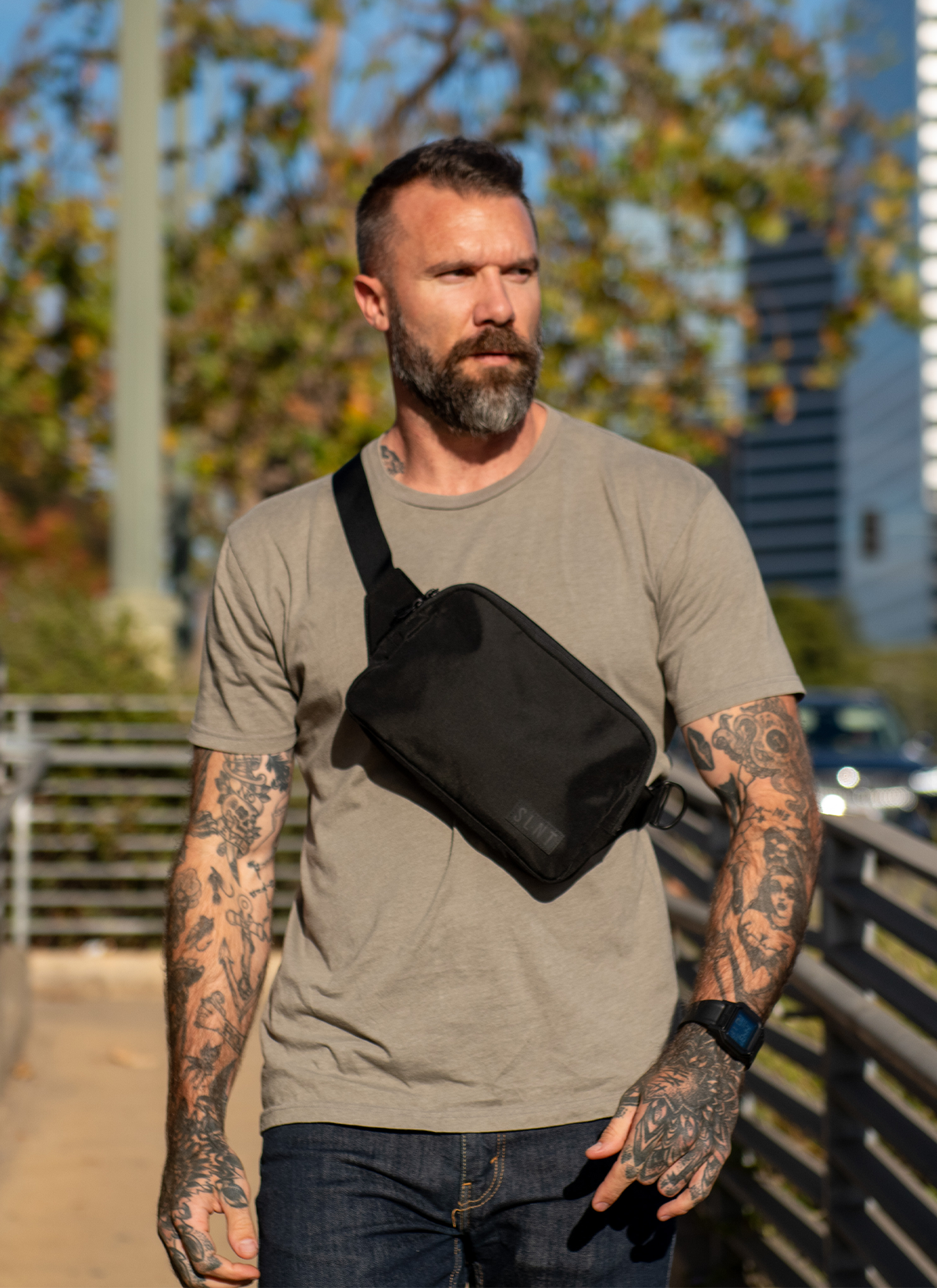

A concealed carry bag has a job most bags don't. It keeps a firearm secure, out of sight and reachable, while the rest of your day rides along with it. Backpack or sling is the first call. Five questions settle the rest.
Five questions to answer first
- Carrying format. A backpack spreads the load across both shoulders and holds a full day of gear. A sling rides on one strap and carries less. Pick the one that matches how you move and how much you bring.
- Storage needs. List what goes in every day: phone, laptop, documents, med kit. Compare that list with the published capacity, not the size name.
- Compartment layout. Check where the firearm goes, whether that space is separate from everything else, and how it's lined. A loop-lined panel lets you place a velcro-backed holster where you want it.
- Closures. Look at the zippers and pulls on the carry compartment, which hand they favor, and whether they lock. Then check how the Faraday compartment closes. It only works fully closed.
- Published compatibility. Go by what the manufacturer states about firearm and holster fit. If it isn't published, ask before you buy. Don't guess from the bag's size.
SLNT models compared
Four models, side by side. Everything here comes from each product page. Where SLNT doesn't state a detail, the table says so.
| Model | Format and capacity | Faraday storage | Layout and closures | Firearm and holster compatibility (as stated) |
|---|---|---|---|---|
| Incognito Faraday Backpack (USA) | Backpack, 25 L | Two removable Faraday bags: one with a roll-down velcro closure, one with a roll-down closure and clip | Two hidden concealed carry pockets, one on each side, with quick-access pull strings. Locking main compartment zippers. Main compartment lined with velcro loops. Luggage passthrough. No external branding. | Not published |
| Concealed Carry Faraday Sling, Medium | Sling, 2 L | Removable Faraday sleeve insert with magnetic closure. Internal: 7.2 x 3.5 in (18.2 x 8.8 cm) | Dual-zipper main compartments, RFID-blocking and soft-loop lined. Front compartment with mesh pockets. Removable zipper pulls for left- or right-hand use. | The product page says the main compartments support compact and full-size pistols. Not stated per size. |
| Concealed Carry Faraday Sling, Medium Plus | Sling, 3 L | Removable Faraday sleeve insert with magnetic closure. Internal: 8.4 x 4.8 in (21 x 12 cm) | Dual-zipper main compartments, RFID-blocking and soft-loop lined. Front compartment with mesh pockets. Removable zipper pulls for left- or right-hand use. | The product page says the main compartments support compact and full-size pistols. Not stated per size. |
| Incognito Faraday Sling (USA) | Sling, 2.5 L | Removable Faraday sleeve insert with magnetic closure, attached with a velcro backing. Internal: 7.2 x 3.5 x 1.5 in (18.2 x 8.9 x 3.8 cm) | Integrated soft loop panel. Ambidextrous. No exterior branding. | Fits a subcompact pistol. Compatible with subcompact pistols and velcro-backed holsters using the soft loop panel. Holster not included. |
Faraday insert sizes are the internal dimensions SLNT publishes. Measure your phone or device with its case on and compare. For full specs, open each product page.
Where the signal blocking happens
Each of these bags carries removable Faraday storage: the insert in the slings, the two roll-down bags in the backpack. Seal a device inside and close it fully, and its cellular, WiFi, Bluetooth and GPS signals are blocked for as long as it stays shut. Leave it open, or run a charging cable through the closure, and they aren't.
The rest of the bag is not a Faraday enclosure. On the Concealed Carry Faraday Sling, the main compartments are RFID-blocking. That covers card and passport chips at 13.56 MHz, not a phone's cellular, WiFi or GPS signal. Phones go in the insert.
Sealing a phone cuts its wireless connections. It doesn't switch off the microphone. And the Faraday compartment handles one thing: wireless access while the device is inside. Passwords, updates and how you use your devices still do the rest.
U.S. air travel
Flying with a firearm runs on TSA rules, not bag design. Under TSA guidance on transporting firearms, firearms travel only as checked baggage, unloaded, in a locked hard-sided container, and you declare them to the airline at the ticket counter. Firearms, firearm parts and ammunition aren't allowed in carry-on bags.
A soft backpack or sling doesn't replace that locked hard-sided case. Airlines add their own rules and fees, and state, local and international laws apply wherever you land. Check all three before every trip.
Pick your carry
Need a full day of gear and two Faraday bags? Start with the backpack. Want to carry light with the essentials close? Look at the slings. See all three side by side in the Concealed Carry Faraday Bags collection.