
Why Aluminum Foil Does Not Make a Real Faraday Cage

You wrap your phone in a few layers of kitchen foil, watch the bars drop, and figure you cracked it.
Then a call comes through.
So much for the hack.
Here is the direct answer: aluminum foil can block some signals in theory, but it does not make a reliable Faraday cage. A real Faraday cage needs continuous, gap-free conductive coverage and a sealed closure. Foil tears, leaves seams and folds, and gives results you cannot trust. Signals slip through the openings you cannot see.
The problem is not the metal. It is everything around the metal.
Does Aluminum Foil Block Signals?
A little, sometimes, if you are lucky.
A Faraday cage works by wrapping something in a complete conductive shell. Done right, that shell stops electromagnetic signals from getting in or out. The science is old and solid. Michael Faraday demonstrated it in the 1830s, and you can read the basic principle in plain terms from sources like Encyclopaedia Britannica.
The catch is in one word: complete. A cage only works if the cover is continuous. Any gap bigger than a fraction of the signal's wavelength is an open window. Cellular, WiFi, GPS, and Bluetooth all run at high frequencies, which means even small openings let them through.
Foil almost never gives you complete coverage. That is why the call still rings.
Why Foil Fails as a Faraday Cage
It is not one flaw. It is a stack of them.
-
Seams and folds. Wrap a phone and you create overlaps and creases. Each one is a potential gap where signal leaks.
-
Tears and pinholes. Foil rips if you look at it wrong. A single pinhole can defeat the whole wrap.
-
Loose contact. The metal has to stay pressed together to act as one surface. A loose fold breaks the shield.
-
No real seal. There is no engineered closure. The opening where you slide the phone in is the weakest point.
-
No consistency. One wrap blocks signal, the next one does not. You have no way to know which you got.
A shield you cannot trust is not a shield. It is a guess wrapped in tin.
What a Real Faraday Cage Needs
Reliable shielding is not about more foil. It is about engineering the things foil gets wrong.
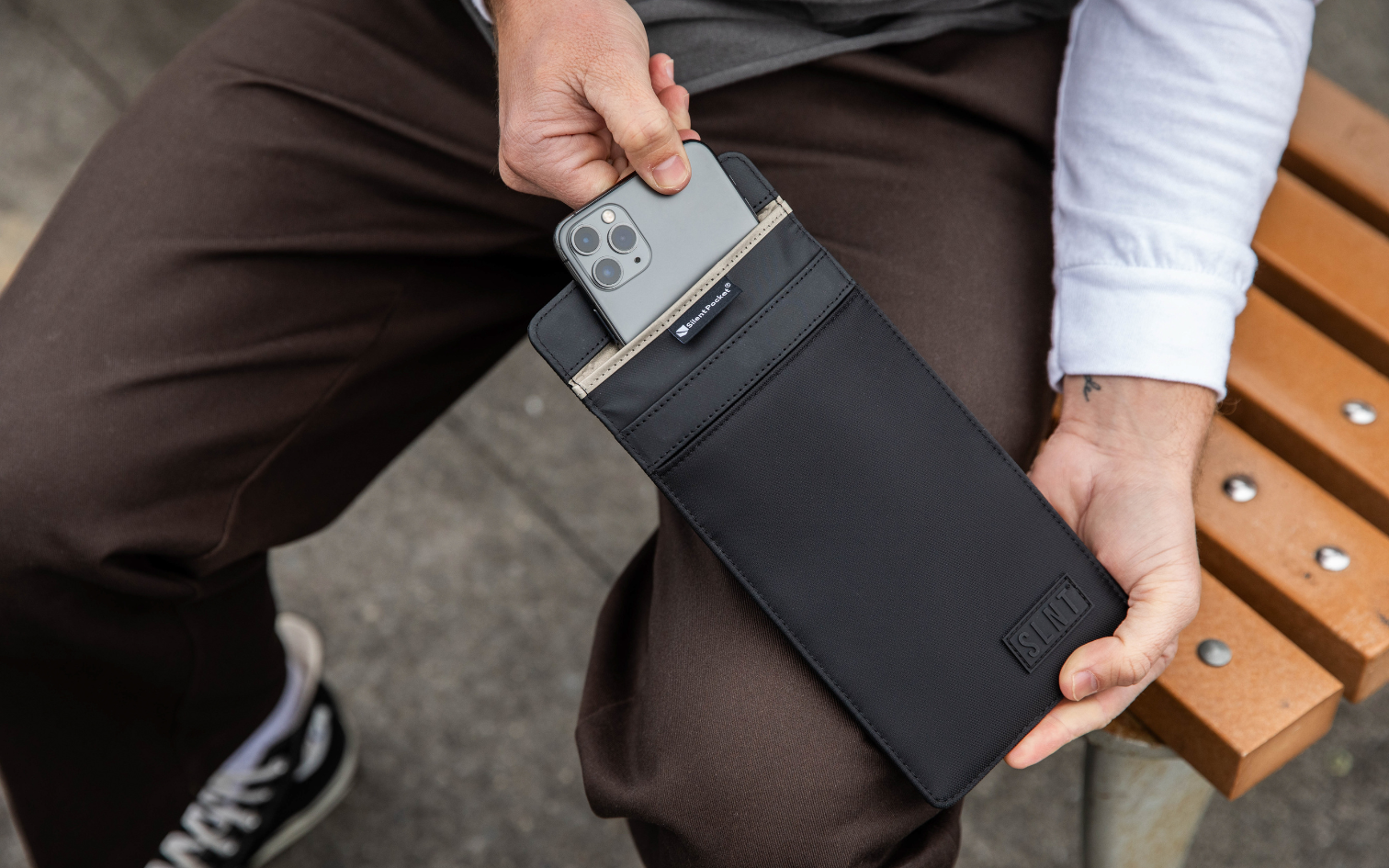
A real Faraday enclosure uses conductive fabric built in continuous layers, with no gaps to leak through. It uses a sealed closure, like a roll-top, so the opening stays shielded when it is shut. And it is measured, not assumed. Shielding strength is tested and rated, so you know it actually blocks the signals it claims to.
That is the difference between a kitchen experiment and gear you can rely on. SLNT products are independently tested, protected by patented technology, and were built for Special Operations and military use before they reached everyday carry. The result is a complete, sealed, repeatable shield. Every time, not when you are lucky.
One straight fact, because precision matters. A Faraday enclosure stops signals from leaving your device. It does not turn off the microphone, since the mic is built into the phone. The phone can still hear. Nothing it hears can transmit out of a sealed enclosure. Block the signal, block the leak.
Where Real Shielding Earns Its Keep
This matters anywhere a wrap of foil would let you down.
For daily carry, a Faraday phone sleeve goes dark the moment you seal it, with no folds to second-guess. Drop your phone in during a meeting that matters and nothing transmits out.
Traveling, a sealed enclosure keeps your devices off the grid through airports and hotels far more reliably than anything you could improvise. For your car, a proper key fob pouch kills the signal relay thieves use, which a loose foil wrap will not do consistently.
For crypto custody, a Faraday bag shields a hardware wallet from wireless access and remote tampering. That is real protection for real value, not a foil packet in a drawer. And at home, dropping a phone into a sealed bag at night cuts the late-night pings, with the side benefit of less EMF exposure near your head while you sleep.
None of these ask you to trust a wrap job. They give you a shield that was built and tested to hold.
Why It Matters
The whole point of shielding is certainty. You either blocked the signal or you did not.
Foil leaves you in the gray zone. Maybe it worked. Maybe a seam let a tracker phone home or a reader pull your data. With a tested enclosure, there is no maybe. You know your device went silent, because the gear was made to make it silent.
That certainty is the real product. Not metal, but control you can count on.
Skip the Guesswork
Aluminum foil is a fun science demo. It is not a privacy plan.
A real Faraday enclosure does the one thing foil cannot promise: it blocks the signal completely, every time, by design.
If you want shielding that is tested to hold, take a look at how SLNT gear fits into everyday life. No urgency, no pitch. Just protection that works the same way twice.