Signal-blocking protection in co-working spaces: what works and what doesn’t


Working from a coworking space is like having a private conversation in a crowded café. You’re focused. Everyone else is busy. But the walls are thin, the room is loud, and your devices are constantly talking, whether you want them to or not.
Coworking feels flexible and modern. Digitally, it’s one of the noisiest environments you can put your phone or laptop in.
The problem: shared spaces mean shared exposure
Coworking spaces are built on shared infrastructure. Shared WiFi. Shared Bluetooth devices. Shared access points. That convenience comes with tradeoffs.
Here’s what’s actually happening in the background:
-
Persistent tracking: Phones and laptops continuously broadcast identifiers through WiFi, Bluetooth, and cellular connections. That data can be logged, correlated, and analyzed.
-
Credential exposure: Public networks increase the risk of credential harvesting, session hijacking, and man-in-the-middle attacks.
-
Proximity surveillance: Bluetooth beacons and nearby devices can map movement patterns inside shared offices.
-
Metadata leakage: Even when apps are closed, devices still transmit timing, location, and device fingerprints.
Turning on airplane mode helps, until you turn WiFi back on. VPNs encrypt traffic, but they don’t stop signals from broadcasting. Software tools manage data after it leaves the device. They don’t stop transmission in the first place.
That’s the gap most people miss.
The solution: physical signal control
If the problem is signal transmission, the fix is simple and physical.
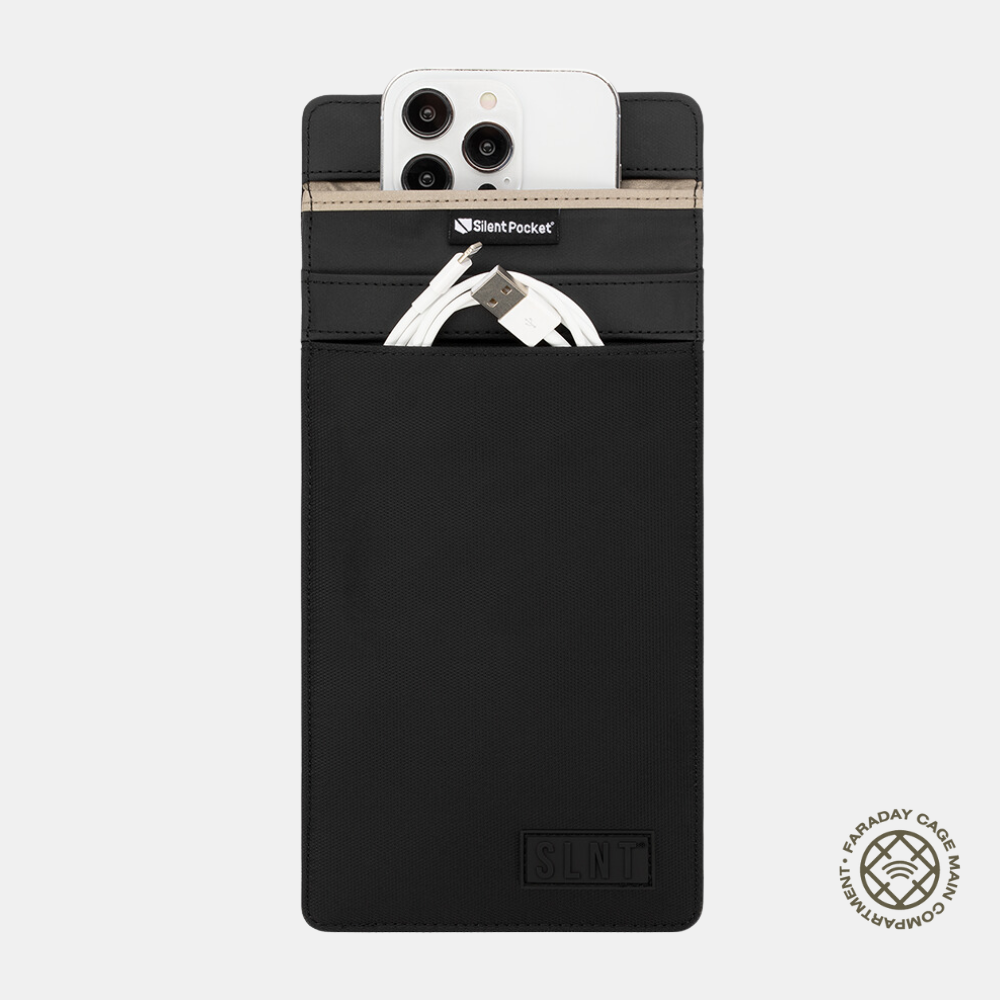
Faraday protection blocks wireless signals at the hardware level. When a device is inside a Faraday bag or sleeve, cellular, WiFi, Bluetooth, GPS, RFID, and NFC signals cannot enter or exit. No signal. No tracking. No background communication.
This isn’t software. It can’t be updated around. It doesn’t rely on settings or permissions. It’s physics.
Important clarity: Faraday bags donot stop the microphone from listening, because the microphone is built into the device. What Faraday protection does stop is the wireless transmission of audio, data, or location while the device is shielded.
SLNT® gear uses patented Faraday technology, independently tested and originally developed for military and operational environments where signal discipline matters.
How signal-blocking fits into coworking life
You don’t need to live off-grid to benefit from signal control. In coworking spaces, it’s about choosing when your devices are active, and when they’re not.
-
During meetings, a phone inside a Faraday sleeve stays fully offline. No location pings. No Bluetooth scanning. No interruptions.
-
Between work sessions, storing your phone in a Faraday pocket inside a backpack keeps it from broadcasting while you focus.
-
For freelancers juggling multiple clients, shielding secondary devices prevents cross-account tracking and background sync.
-
When stepping away for calls or breaks, devices left at your desk aren’t quietly communicating with the network.
-
For shared desks and hot-desking, Faraday storage adds a layer of protection against proximity-based attacks and passive tracking.
Think of it like closing a door instead of trusting everyone to look away.
What works vs. what doesn’t
What actually works:
-
Physical Faraday bags and sleeves that block all wireless signals
-
Using signal blocking during downtime, meetings, and storage
-
Combining hardware protection with basic software hygiene
What doesn’t:
-
Relying on airplane mode alone
-
Assuming VPNs stop tracking (they don’t stop broadcasting)
-
Trusting public WiFi because it has a password
-
Believing “screen off” means “signal off”
This distinction matters, especially in shared environments.
Why it matters
Privacy isn’t secrecy. It’s control.
In coworking spaces, control gets blurred. Devices stay connected because the environment expects it. Over time, that constant exposure becomes normalized.
Signal-blocking protection restores boundaries. It gives you:
-
Autonomy: You decide when your devices talk.
-
Security: Fewer opportunities for data leakage and interception.
-
Mental clarity: Less noise, fewer interruptions, more focus.
-
Operational discipline: Especially important for founders, journalists, developers, and anyone handling sensitive work.
Reduced EMF exposure is a secondary benefit when devices are shielded, but the real value is control over your digital footprint.
The bottom line
Coworking spaces aren’t the problem. Blind connectivity is.
Software tools manage risk after the fact. Faraday protection stops it at the source. Physical signal control turns constant exposure into a conscious choice.
You don’t need to disconnect forever. You just need the ability to disconnect on your terms.
That’s how you work focused, move deliberately, and protect what matters, without making a scene.