The Anxiety Loop: How Your Phone Keeps You in a Constant State of Stress


You're tense before you even open your eyes.
Your hand reaches for the phone. Lock screen lights up. Twenty-seven notifications. A work email. A breaking news alert. Three texts you forgot to answer last night. Your jaw tightens. Days barely started, and you're already behind.
That's not an accident. That's the system working exactly as designed.
Your Phone Was Built to Keep You On Edge
Modern smartphones aren't communication tools. They're attention machines. Every buzz, banner, and notification is engineered to trigger the same threat-response circuit your brain uses to scan for danger.
The result? You live in a low-grade fight-or-flight loop. All day. Every day.
Research from the American Psychological Association consistently links constant connectivity to elevated stress, sleep disruption, and reduced focus. Your nervous system can't tell the difference between a real emergency and a Slack ping. It just reacts.
And the phone never stops asking.
The Anxiety Loop, Step by Step
-
A notification fires.
-
Cortisol spikes.
-
You check.
-
Brief dopamine hit.
-
Crash.
-
Repeat.
Hundreds of times a day.
You don't feel it as panic. You feel it as a hum. A background tightness. A weird inability to sit still without reaching for the screen. That's not a personality flaw. That's phone addiction by design.
It's Not Just the Notifications
Even when you're not looking at it, your phone is working.
It pings cell towers. Negotiates with WiFi networks. Logs GPS coordinates. Talks to Bluetooth devices in your house, your car, the coffee shop down the block.
That signal traffic doesn't only create privacy and tracking exposure. It tethers you. Knowing the device is live keeps part of your brain locked in standby mode, ready to respond.
Airplane mode helps. Sort of. But it's a software toggle. One update, one accidental swipe, and you're back online without realizing it. And on most phones, certain radios, Bluetooth, ultra-wideband, location services, can stay active even when you think you've shut everything off.
If you want a real break, you need a hard line. Not a setting.
The Hardware-Level Off Switch
This is where Faraday gear comes in.
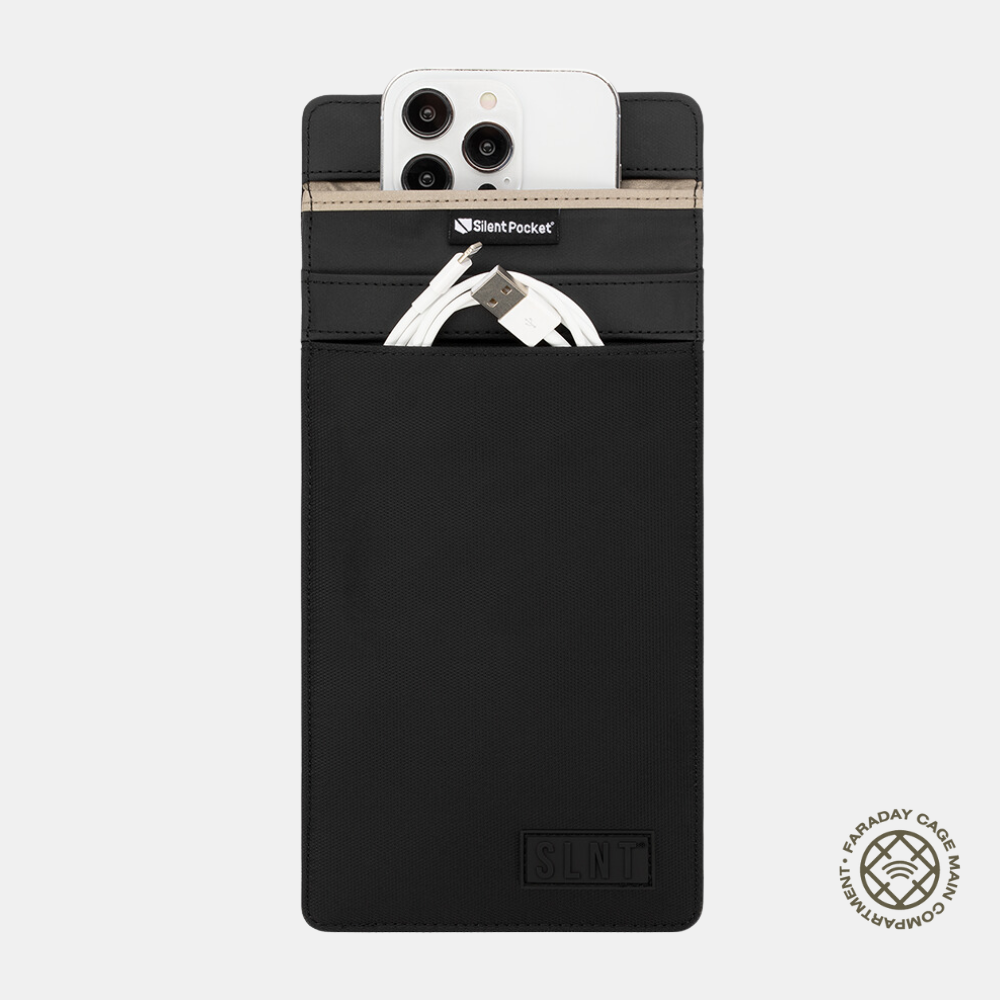
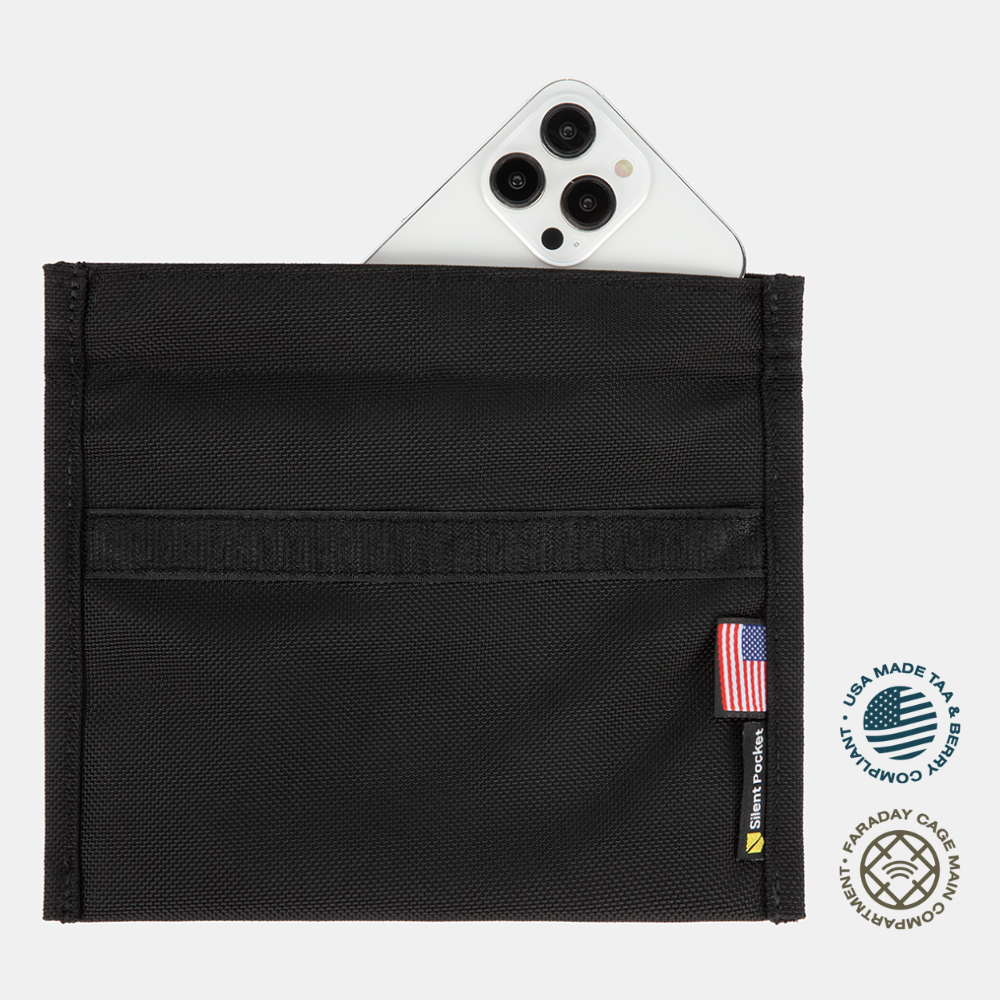
A Faraday bag is a physical, signal-blocking enclosure. The lining is built from advanced conductive materials that block every wireless signal a phone can send or receive: cellular, WiFi, Bluetooth, GPS, RFID, NFC.
Drop a phone inside. Seal it. The phone goes dark. No incoming. No outgoing. No background syncing. No location pings. No "just one more check."
It's not a feature. It's physics.
Quick definition: A Faraday bag is a portable Faraday cage. It uses conductive material to block all wireless signals to and from any device placed inside. No app. No setting. No software dependency.
A few things to know up front.
Faraday gear doesnot block the microphone. The mic is built into the device itself.
The protection is hardware-based. Nothing to install. Nothing to update. Nothing to remember when you're tired.
SLNT's gear is patented, independently tested, and originally built for Special Operations. The same engineering that gets used by government and defense teams now sits in your laptop bag, your nightstand, or your kitchen counter.
Where This Fits in a Real Day
You just need to learn to silence the chaos.
Drop your phone in a Faraday phone sleeve on the nightstand at night. The room actually goes dark. No buzzing on the floor at 2 a.m. No blue light at 3 a.m. when you reach for it out of habit. You sleep like the network doesn't exist, because for you, it doesn't.
Bring a Faraday pouch to dinner. Phone goes in. Conversation comes back. Nobody checks anything. Nobody apologizes for checking. The night is yours.
Use one during deep work. A sleeve on the desk replaces the willpower battle with a closed door. The phone can't reach you, and you can't reach it without making a real decision first. That little bit of friction changes everything.
Take one in the car. Phone in the bag means it's not pinging towers, not tracking your route, not lighting up at every red light. You drive. That's it.
Pack a Faraday travel bag for vacation. Most people come back from a week off more wired than when they left, because the phone never stopped pulling. Sealed gear turns "off" into actually off, no work emails sneaking in through hotel WiFi, no apps quietly working in the background while you eat dinner.
Hand one to your kids during family time. Set the rule. Phones go in the pouch. Watch what happens to the room.
Why This Actually Matters
This isn't about hating technology. It's about choosing when it gets access to you.
Your attention is the most valuable thing you own. Apps know that. Advertisers know that. The whole internet is built on harvesting it. The first move in getting it back is putting a wall between you and the device, a wall that doesn't depend on your discipline at 11 p.m. when you're tired and scrolling.
There's a quieter benefit too. When the phone is shielded, it stops emitting wireless signals, which means less EMF exposure for whoever's nearby.
Privacy. Focus. Sleep. Presence. Those aren't luxuries. They're the things you have to actively defend now.
A real digital detox doesn't need a retreat or a willpower contest. It needs an off switch you can trust.
The Quiet Move
You don't need to delete your accounts. You don't need a cabin in the woods. You don't need to perform a digital detox on Instagram.
You just need a way to put the phone down and actually mean it.
That's what this gear does. It's been trusted in the field by Special Operations and government teams who can't afford a leak. The same engineering now sits in a sleeve on your desk, ready to give you back a few hours of your own head.
Explore SLNT's Faraday phone sleeves and decide for yourself when the world gets access to you.
The chaos doesn't stop on its own.
You silence it.