
GPS Tracking and Smartphones: Your Location Can Be Tracked With Your Phone Number

Can Someone Track My Location By My Phone Number?
Usually not with the number alone. Someone can track your phone's location if you click a tracking link they send you, if you've agreed to share your location in an app (like Life360 or Find My), or if they get access to your phone or to your carrier's data. Here's how each one works and how to protect yourself.
In the past, tracking someone’s location meant that you had to install a GPS tracker on their vehicle. Now, tracking a cell phone location in real-time with nothing more than a phone number is possible. Find location by number feature is also increasingly becoming more available.
Whether you use an iPhone or Android phone, someone can track you without your knowledge by simply getting you to click a link or download an app. It's not always clear that you're granting permission to share your location data.
In fact, you can find offers all over the internet advertising tracking services. Most major cell phone carriers offer services that allow sharing your location between friends and family members. Some spy apps even draw you in by offering to catch your cheating spouse.
If you value your privacy as much as we do, spyware and tracking apps are cause for concern for data leaks and lack in privacy.
Phone Tracking Apps
Apple's "Find My" app, Google Maps, and the popular tracking apps such as Life360make it handy for tracking family members. But we have to ask if this technology can cross the line? And can someone track your phone number without your permission? Absolutely.
Beware of companies such as Localize.mobi offering to track the location of both Android and iOS phones for a monthly fee. Here's how it works:
1) The user enters a cell phone number to track on the Localize.mobi website.
2) The site sends a text to the target device with customizable wording and a link.
3) If the target device owner clicks the link, their phone's location appears under "located numbers" on a map.
The sneaky thing about tracking apps like this is that no app or software is required, and the target device owner may not understand that clicking a link allows someone to track them. And just like that, privacy and security are compromised.
Another phone location tracking app is Glympse, which doesn’t require installation or creating an account to use it. Unlike other tracking apps, it allows users to share GPS tracking data with links in real-time. This information can also be posted and shared on social media platforms, which is a concern for lack in privacy, and data leaks.

Is Life360 safe?
While the Life360 tracking app can be helpful for parents watching over their children, particularly teens and new drivers, it also presents security risks.
The Life360 terms of service agreements require ‘permission-based tracking.’ To participate in mobile tracking from someone like your employer, you must respond positively to the text message Life360 sends you before it tracks your location and delivers that data to your tracker.
Using a service like Life360, your family would also have to opt in and give permission to the tracking, or you would opt in on behalf of your minor child. While marketed as an app that promotes family and driver safety, users should be aware that Life360 has been known to sell its user data to third-party companies.
Does Life360 sell your data?
Life360 has stored and sold location information, history, and driving stats to advertisers, insurance companies, and other third parties. Most users were unaware of this until it was exposed online. In January of 2022, Life360 announced that they would stop selling users' location data.
As of October 2026, Life360's privacy policy says it may share certain information, including precise location and movement data, with select business partners for their own uses, while giving users options to opt out through the app's privacy settings.
It's up to users to decide if they trust a tracking app with their sensitive personal information. Even if personal data isn't sold,all it takes is one security breach to compromise location data and other private information.
If you're looking to use Life360 to catch your cheating spouse, keep in mind that installing tracking software on the electronic device of a spouse, significant other, or unsuspecting person isn't legal in the US. You could find yourself facing hefty federal fines and imprisonment for doing it.
Cell Phone Tracking by IP Address
Cell phone tracking by IP address is a practice that allows law enforcement and cell phone carriers to identify the physical location of a cellular device. This information is gathered from a user’s IP address, which is assigned to their phone. It usually shows only an approximate area, such as the city or the carrier's network, not your exact GPS position.
The U.S. Department of Justice, the Federal Bureau of Investigation, and the U.S. Marshals Service have all relied on cell phone tracking technology of some form to track individuals in investigations like robberies and kidnappings, as well as fugitives who are sought after by law enforcement.
Do Cell Phone Companies Track Cell Phones?
Cell phone companies track the location of their cell phones, but this tracking may not be as precise as that provided by law enforcement. The practice is most often done through the company's IP address system, which periodically logs each device's assigned Internet Protocol (IP) address. IPs are used to identify computers on the Internet and determine where they are located.
Phones can also find their own location through GPS: the phone receives signals from satellites and calculates its position from how long those signals take to arrive. Apps and carriers can then see that location if the phone shares it.
But what happens if this tracking technology falls into the wrong hands? You've got to protect yourself.
In April 2024, the FCC fined AT&T, Sprint, T-Mobile and Verizon nearly $200 million for sharing customers' location data without their consent.
How Do I Protect Myself From GPS Tracking?
There are many ways to protect yourself from GPS tracking. Here are our recommendations:
1) Turn off location services.
If you want to protect yourself from GPS tracking, make sure your phone is not connected to any social media apps or online maps. If you're using an older model cell phone and want to avoid being tracked, turn off the GPS function altogether.
On iPhone: Settings > Privacy & Security > Location Services. On Android: Settings > Location.
2) Use encrypted messaging apps.
The best encrypted instant messaging appsput your privacy and security first. Apps such as Signal and WhatsApp are popular for Android and iPhone users. These messaging apps have powerful encryption software that makes messages unreadable to anyone intercepting them without your permission.
3) Know who has access to your phone.
It's important to know where your phone is at all times and, most importantly, who has it. If someone can physically access your phone, they could install any number of malicious GPS tracking apps. Maintain a secure password or Face ID. Only share passwords with trusted individuals.
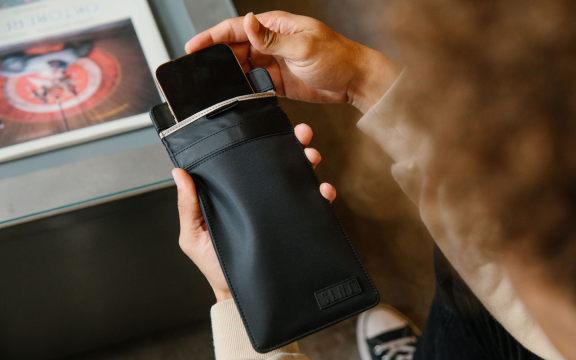
4) Keep your phone in a Faraday phone bag.
Utilize a Faraday cagewhen your phone is not in use.A Faraday cage is a device that is designed to block electromagnetic radiation and radio waves. The cage consists of two or more conducting surfaces that enclose airspace between them.
Putting your phone into aphone bag with Faraday cage instantly cuts off ALL signals to and from your phone. Faraday phone sleeves make tracking impossible so long as it remains inside the sleeve.
5) Run Safety Check on your iPhone.
Run Safety Check on your iPhone (Settings > Privacy & Security > Safety Check) to see who you're sharing your location with and stop it in one place.
How to Block GPS Tracking with SLNT Products:
If you still ask, "Can people track your phone number?" and wonder how to protect yourself, consider using a Faraday phone bag.With SLNT®, patented technology blocks all signals from reaching your mobile devices, creating a 'Faraday cage' around them. This impenetrable shield blocks radio frequency signals emitted and received by your device. Security doesn’t get any simpler than this.
Your privacy and peace of mind are in your hands. Explore ourFaraday bag collections to determine which security product is right for you.
FAQ: Phone Location Tracking
Can someone track my location on Google Maps with my phone number?
No. Google Maps only shows your location to people you've chosen to share it with in the app.
Can the police track my phone?
Yes, through your carrier. In the US, police generally need a warrant to get your past location records from your carrier.
Does Life360 sell your data?
Life360 announced in January 2022 that it would stop selling users' precise location data. However, as of October 2026, its privacy policy says it may share precise location and movement data with select business partners for their own uses, and users can opt out in the app's privacy settings.
This article was updated & reviewed by SLNT'sPrivacy Experts on 05/18/2026.