
Do Faraday Bags Work? These 4 Tests Reveal the Truth
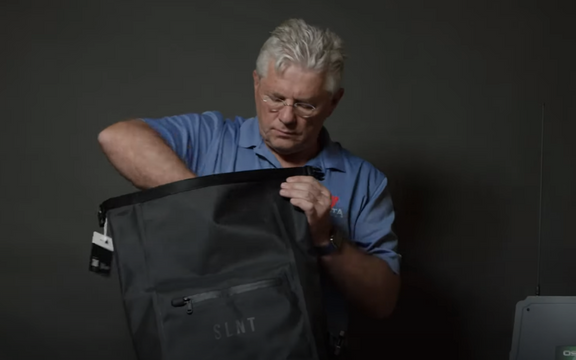

Are you looking to protect your privacy and devices from tech-savvy thieves?
Data and car theft are real concerns, and many claim that Faraday bags block thieves from accessing your private information. But do Faraday bags work? And is there enough proof to give you peace of mind? Let's find out.
What Is A Faraday Bag?
The Faraday bag, similar to a Faraday cage, is a simple shielding device. Faraday bags protect your valuables from being stolen by storing them inside a metal mesh enclosure. This protective bag blocks the wireless signals your devices use to connect: cellular, GPS, Wi-Fi, Bluetooth and RFID/NFC.
Can a Faraday bag protect against an EMP?
The principle of the Faraday bag is to prevent radio frequencies from escaping, leaving you untraceable, untrackable, and unhackable.
How Faraday Bags Work
Faraday bags are designed to shield your electronic devices fromelectromagnetic radiation used to alter your data or track your device. A Faraday bag is a fabric or leather sleeve lined with metal mesh used toblock all signals, including electromagnetic radiation. When radio signals or an electric field come into contact with the bag, the signal is grounded and cannot pass through to the device or the person carrying the Faraday sleeve.
How Effective Are Faraday Bags?
You might be wondering, "Do Faraday bags really work?" We called upon Emmanuel Ladsous, retired FBI Supervisory Special Agent and Founder ofDelta 7 Group, to check the signal-blocking capabilities of theSLNT® Faraday Phone Sleeve.
| Test | Signal | How it was checked | Result |
|---|---|---|---|
| Bluetooth Signal Speaker Test | Bluetooth | A phone playing music on a Bluetooth speaker was put in the sleeve. | The music stopped and the connection was lost. |
| Wi-Fi Faraday Test | Wi-Fi | One phone was placed inside the sleeve while attempting to connect to a Wi-Fi router, and the connection was checked with a network analyzer. | The enclosed phone was no longer connected to the Wi-Fi router. |
| Faraday Bag RF Test | RF | An RF transmitter was placed inside the bag and its signal was monitored with a spectrum analyzer. | The signal disappeared when the bag was closed and reappeared when it was opened. |
| Cellular Connection Test | Cellular | A phone was called before and after being placed in the sleeve. | The phone did not ring after being enclosed and disconnected from the cellular network. |
Test video published in 2022.
To perform these tests, Private Investigator Ladsous uses a spectrum analyzer that measures radiofrequency (RF) energy. What we want to determine is whether or not RF energy can escape from the bag.
There are four Faraday security tests: Bluetooth, Wi-fi, RF, and cellular.
1) Bluetooth Signal Speaker Test
For the first test, we connect the Bluetooth module in the phone with a Bluetooth speaker. While connected to the speaker, we're able to play music. Hearing music from the speaker means the phone is linked to the speaker over Bluetooth.
Once the cell phone is inside the SLNT® sleeve, the music stops, and the Bluetooth link instantly disappears, demonstrating that the Faraday sleeve has successfully blocked Bluetooth signals.
2) Wi-fi Faraday Test
We perform this test with two cell phones; one is inside the sleeve, and one is outside the sleeve. One phone connects to the hub, and the other is inside the sleeve, attempting to connect to the hub.
Using this network analyzer, we can see that the enclosed phone is no longer connected to the wifi router. Based on these results, we can see that the SLNT® sleeve effectively blocks Wifi signals.

3) Faraday Bag RF Test
For the next test, we use an RF transmitter 12 times more powerful than the Bluetooth and the Wifi module in the phone. This RF transmitter is designed to go through walls and capture a signal a mile away.
The spectrum analyzer measures the energy level in the spectrum. The US government and law enforcement use this analyzer to look for covert listening devices, including Bluetooth, Wifi, and cellular devices. Each of the spikes on the spectrum analyzer is an AM/FM radio transmitting.
Once the transmitter is inside the bag, the signal disappears. When we open the bag, the signal reappears; this is the importance of a secure enclosure. The signal immediately appears and disappears when the bag is opened and closed. You don't even have to take it out of the sleeve. Close the bag, and the signal is gone.
Results: the SLNT® Faraday bag effectively blocked this quite strong signal.

4) Cellular Connection Test
We want to determine whether the SLNT® sleeve effectively blocks the cellular signal. We place a call to a cell phone, and you can see that the phone connects to the cell site.
When we place the phone inside the SLNT® sleeve and place another call, the phone does not ring. The reason is that the cell phone disconnects from the network. In other words, the network does not know where the phone is, so it does not connect.

What the lab report shows
Independent testing by Keystone Compliance measured the shielding performance of SLNT's Multishield® material. The three-layer material was tested from 10 kHz to 1 GHz and reported compliance with MIL-STD-188-125-2. The single-layer Multishield® material was tested from 1 to 40 GHz, with measured signal attenuation ranging from 79.8 to 94.9 dB.
These laboratory results apply to flat material samples, not complete Faraday bags. The performance of a finished product also depends on its construction, seams and closure.
For the full results and testing methods, see the SLNT Testing page.
Do Faraday Bags Work for Key Fobs?
In today's world, one of the most common ways to steal a car is by cloning the encrypted signal of the keyless car fob. This duplication allows the thief quick access to unlock your vehicle's doors and drive away. While we didn't include this in our test with Ladsous, the same principle applies to key fobs as to cell phones.
A Faraday bag will protect your keyless entry fob from being hacked and used to start your car without you knowing. Faraday sleeves protect valuable devices from electronic pickpockets and vehicles from electronic car thieves.
Faraday bags work by blocking all electromagnetic waves, including RFID signals, so data cannot be accessed remotely. This protective feature prevents hackers from accessing your data or tracking you with your GPS coordinates.
Smart car keys are vulnerable to hacking and give thieves electronic access to remotely open and potentially steal your car. We recommend protecting yourself withSLNT® key fob guards if your car uses a remote key system.
Do Faraday bags work with today's phones and car keys?
Our lab tests measured how much signal the shielding material blocks between 1 and 40 GHz (single layer) and between 10 kHz and 1 GHz (three layers). That covers the signals phones and car keys use today: key fobs (125 kHz, 315/433 MHz), NFC and RFID cards (13.56 MHz), GPS (about 1.2–1.6 GHz), Bluetooth and Wi-Fi (2.4–7 GHz), most 4G/5G bands (below 7 GHz) and the ultra-wideband (UWB) used by newer phones and digital car keys (about 6–8.5 GHz). These results are for the material, not for every finished product.
Data Protection: Are You Safe?
Faraday bags are one of the best ways to protect your personal belongings from being hacked.
"In my opinion, you're not safe," says Ladsous.
"Anytime you use your cell phone, it gives you a false sense of security. The concern is not just the operating system; it's all the apps on your phone. Spying on you could not be through the operating system, but it can be through an app on your phone. Even the watch on your arm is essentially a cell phone."
So what does Ladsous recommend?
"The Faraday helps. A hundred years from now, the cell phone will still need radio frequency to connect to a network. Faraday will always be effective against RF because RF is how everything is in this day and age. Everything is wireless—wireless means RF, and the material in this bag blocks RF."
Want to learn more about protecting your mobile privacy, security, and health? Follow us onInstagram, and check out ourblog for the latest safety information and SLNT® Faraday products.
FAQ: Faraday Bag Effectiveness
Are Faraday bags EMP proof?
A closed, undamaged Faraday bag is designed to shield electronics from an EMP. Our published lab tests measure how much radio signal the material blocks; read more in our EMP guide.
How long does a Faraday pouch last?
As long as the shielding layer isn't torn or worn out. Test it from time to time and replace it if a phone inside still rings.
Do Faraday bags work for key fobs?
Yes, Faraday bags shield key fobs by blocking their wireless signals, helping prevent thieves from intercepting or relaying those signals to unlock a car. The same signal-blocking principle used for phones applies to key fobs, even though they weren't included in the four tests described above.
How can I test my Faraday bag at home?
Put your phone inside, close the bag fully and call it. If it doesn't ring, the bag is blocking the signal.